Property Consultation: From Budget to Keys, Step by Step

Written by the BrickNova Property Advisory Team — a Kochi based real estate channel partner serving verified buyers across Kochi, Trivandrum, and Kozhikode.
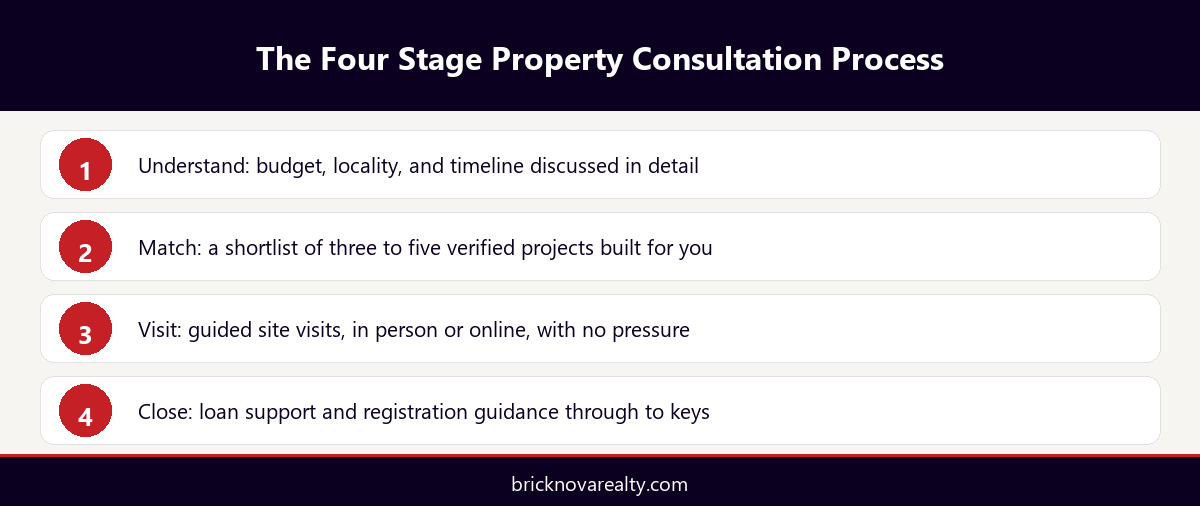
A property consultation sounds like a simple first meeting, but a well structured one is what actually determines whether the rest of your home buying process feels organized or chaotic. Rather than jumping straight to a site visit, a proper consultation moves through four distinct stages: understanding what you actually need, matching you with verified projects, arranging visits without pressure, and closing the purchase with loan and registration support. This guide walks through each stage in detail, what to expect at each step, and how to tell whether the consultation you are getting is genuinely structured or just a sales conversation wearing a different name.
Most buyers only go through this process a handful of times in their life, so there is little natural opportunity to learn what a well run consultation should look like. Treating the first meeting as a structured process with clear stages, rather than a casual conversation that happens to end with a site visit, changes how much value you get from every conversation that follows.
Key Takeaways
- A genuine property consultation follows a clear sequence: understand, match, visit, close.
- Skipping the understanding stage usually leads to shortlist mismatches later in the process.
- Support should continue through loan approval and registration, not stop at the site visit.
- A well run property consultation is the foundation every later stage of the purchase builds on.
Stage One: Understanding Your Budget, Location, and Timeline
Every useful property consultation begins with questions, not project names. A property consultant worth working with will ask about your total budget including registration costs, your preferred locality or list of acceptable localities, your timeline for moving in, and whether the purchase is for personal use or investment. These answers shape every recommendation that follows, and skipping this stage is the most common reason buyers end up touring projects that never suited them in the first place.
This stage also includes discussing what happens if your priorities change partway through the search. Buyers sometimes discover, after visiting a few projects, that a locality they initially ruled out actually suits them better than expected, or that their budget can stretch slightly further than planned once financing options are clearer. A good consultation treats these adjustments as normal rather than starting the entire process over from scratch each time a preference shifts.
Some buyers also enter a consultation with a fixed idea of what they want, only to find their priorities shift once they see real options in person. This is a normal part of the process rather than a sign that the initial understanding stage failed, and a good consultant treats revised preferences as useful new information rather than a frustrating change of plan.
It is worth being specific during this stage rather than giving broad answers. A budget range described as flexible, or a locality preference described simply as somewhere in Kochi, gives a consultant very little to work with. Narrowing your answers, even roughly, produces a shortlist that reflects your actual priorities rather than a generic set of popular projects across the entire city.
Why Budget Needs to Include More Than the Sale Price
Many first time buyers quote a budget based only on the flat’s sale price, forgetting registration charges, stamp duty, and other statutory costs that can add a meaningful percentage on top. A good consultation clarifies this early, so the shortlist that follows is realistic rather than requiring downward revision later.
Why Timeline Changes the Recommendation
A buyer who needs to move in within six months has a fundamentally different shortlist than one who can wait two years for a project to complete. Stating your timeline clearly during this first stage prevents wasted site visits to projects that cannot realistically meet your schedule.
Buyers with flexible timelines sometimes assume this stage does not apply to them, but even a flexible buyer benefits from stating a rough outer limit. A consultant working without any timeline reference cannot distinguish between a buyer open to a three year wait and one who would prefer to move sooner if a suitable option becomes available, which can meaningfully change which projects appear on a shortlist.
Timeline also affects financing conversations later in the process, since a longer construction period gives you more time to improve your loan eligibility or save toward a larger down payment, while a shorter timeline may require finalizing financing arrangements earlier than you initially expected.
Stage Two: Matching You With Verified Projects
Once your requirements are clear, the next stage is matching you with a shortlist, typically three to five projects, that genuinely fit your stated budget and locality. This is where working with a consultant who covers multiple builders pays off, since the shortlist can include options from Sobha, Dreamflower, V-Guard, and other developers rather than being limited to whichever single project a consultant happens to represent exclusively.
Verification matters at this stage too. Each shortlisted project should have a confirmed RERA registration and a clear possession timeline communicated to you before any visit is scheduled, rather than details you discover for the first time while standing at the site.
A project like Sobha Marina One might appear on a shortlist alongside two or three comparable options, giving you a genuine choice rather than a single recommendation presented as the only option. If your consultation produces only one project name regardless of what you asked for, that is a sign the matching stage was skipped entirely.
It also helps to ask why each project was included on your specific shortlist. A consultant who can explain the reasoning, such as a particular project fitting your budget more closely or a specific locality matching your commute requirements, is demonstrating that the matching stage was done carefully rather than assembled from a generic list of currently available inventory.
Stage Three: Guided Site Visits Without Pressure
The visit stage is where many buyers feel the most pressure, since it is the point at which a booking conversation typically begins. A properly structured consultation keeps this stage informational rather than transactional, walking you through each shortlisted project’s construction quality, amenities, and layout options without expecting a decision on the same day.
During visits, pay attention to details beyond the show flat itself, including common area finishing, how well maintained existing amenities look if any phase is already occupied, and how construction debris and worker facilities are managed on an active site. These details often say more about a builder’s day to day standards than the polished sample flat that every visitor sees first.
It is reasonable to visit the same project more than once, particularly at different times of day, before making a decision. Natural light, noise levels, and traffic patterns near a project can vary significantly between a weekday morning visit and a weekend evening one, and a consultant genuinely focused on your satisfaction will accommodate a second visit without treating the request as unusual.
For buyers who cannot travel, whether due to distance within Kerala or because they are based overseas, this stage should also include an online walkthrough option. A consultant unwilling to accommodate a virtual visit for a legitimate reason such as travel distance is limiting your options unnecessarily, especially when video tools make this simple to arrange.
Online walkthroughs work best when they are live rather than pre recorded, allowing you to ask questions about specific rooms, request a closer look at finishing details, or see the view from a balcony in real time. A consultant experienced with remote buyers, particularly NRIs in the UAE, Kuwait, Qatar, or Malaysia, will typically have this process well established rather than improvising it for the first time on your call.
Stage Four: Closing With Loan Support and Registration
The final stage covers everything between choosing a project and actually holding your keys, including loan documentation, referencing the home loan guidelines published by the National Housing Bank where relevant, and coordinating the registration process itself. Consultations that end the moment a booking amount is paid leave buyers to manage this stage alone, which is exactly when unfamiliar paperwork tends to cause delays.
Buyers frequently underestimate how many separate documents a registration actually requires, from identity and address proof to income verification and, in some cases, a no objection certificate from the builder confirming full payment has been received. A consultant who provides this list well in advance, rather than the week of registration, gives you time to gather everything without unnecessary last minute stress.
This stage also covers coordinating with the builder’s finance team where relevant, confirming which banks a project is already empanelled with, and flagging any additional documentation required for self employed buyers or NRIs whose income verification process differs from a standard salaried applicant. A consultant familiar with these variations can prepare you for what to expect rather than leaving you to discover requirements as they come up.
Ask directly, before you begin, whether consultation support continues through this closing stage or stops at booking. The answer tells you a great deal about what kind of relationship you are actually entering into, regardless of how thorough the earlier stages appeared.
Buyers who have already been through this stage once describe the difference clearly: having someone available to answer a question about a registration document on short notice is far less stressful than searching for answers independently at the exact moment a deadline is approaching.
This closing stage is also where buyers most often wish they had asked more questions earlier. Details such as the exact sequence of payment installments tied to construction milestones, or what happens if a payment is delayed by a few days, are far easier to clarify calmly during the understanding stage than to negotiate under pressure once a registration date has already been fixed.
How to Tell a Structured Consultation From a Sales Pitch
The clearest sign of a genuine consultation is sequence. If a conversation jumps straight to a specific project without first asking about your budget, locality, and timeline, the understanding stage has been skipped, and everything that follows is built on assumptions rather than your actual requirements.
Another useful test is asking what happens if none of the shortlisted projects feel right after your site visits. A structured consultation has a clear next step, either expanding the search criteria or revisiting the budget and locality assumptions from stage one. A sales pitch dressed up as a consultation typically has no answer beyond repeating the same project with a different framing.
Pay attention also to pacing. A structured consultation naturally takes place across more than one conversation, since matching and visiting cannot reasonably happen in the same hour as the initial requirements discussion. A single rushed meeting that ends with a request to book immediately has skipped stages rather than moved through them efficiently.
It is fair to ask directly, at the start of any conversation, roughly how many total interactions the process is expected to take before a booking decision. There is no universal correct number, but a consultant able to answer with a rough estimate, rather than pushing for an immediate decision regardless of how many questions remain, is demonstrating the kind of structured thinking this entire guide has been describing.
What to Prepare Before Your First Consultation
Arriving with a few things prepared makes the understanding stage faster and more accurate. A clear sense of your maximum budget including all associated costs, a ranked list of acceptable localities, and a realistic timeline for moving in are the three most useful pieces of information to bring to a first consultation.
It also helps to note any non negotiable requirements upfront, such as a minimum number of bedrooms, proximity to a specific school or workplace, or a preference for ready to move projects over under construction ones. Sharing these clearly at the start avoids spending visit time on projects that were never going to work regardless of price or location.
If you already have a pre approved loan amount or a clear sense of what a bank is likely to lend you based on your income, sharing that figure early can also refine your shortlist meaningfully, since it sets a practical ceiling that a consultant can work within from the very first conversation rather than discovering it later during the financing stage.
It is also worth writing down a short list of questions you want answered before you commit to a project, such as what the maintenance charges are expected to be, whether parking is included in the quoted price, and what warranty or defect liability period the builder offers after handover. Bringing these questions to your consultation, rather than remembering them mid visit, ensures they actually get answered before a decision is made.
Why This Structure Matters More for First Time Buyers
Experienced property investors often know what questions to ask and what red flags to watch for from prior purchases. First time buyers rarely have that background, which makes a structured, sequential consultation far more valuable than a single enthusiastic site visit organized around whichever project is easiest to show that week.
This gap in experience is not a criticism of first time buyers, simply a reflection of how infrequently most people navigate this specific process. A structured consultation compensates for that gap by providing the sequence and checkpoints that an experienced buyer would otherwise apply instinctively based on past purchases.
For more detail on related topics such as evaluating builder track records and understanding possession timelines, our buyer guides are a useful companion to the consultation process itself, particularly for buyers who want to understand the market before their first meeting rather than relying entirely on what a consultant tells them.
Even buyers who have purchased property before in another city often benefit from this structure when entering Kerala’s market for the first time, since local factors such as builder reputation, RERA registration practices, and typical registration timelines vary meaningfully between states.
Age and life stage also play a role in how much this structure helps. Younger first time buyers purchasing their first home often benefit most from the understanding stage, since they may not yet have a clear sense of which locality or property type genuinely fits their lifestyle. Buyers upgrading from a smaller home to accommodate a growing family often already know their locality preferences well and get more value from a thorough matching and visiting stage instead.
A property consultation is only as useful as the structure behind it. Understanding your requirements, matching you with genuine options, visiting without pressure, and closing with real support through registration is what separates a consultation worth your time from a sales conversation with extra steps. If you are ready to book a consultation that follows this structure from the first call through to your keys, BrickNova can walk you through each stage across builders in Kochi, Trivandrum, and Kozhikode.
A well run property consultation is the single most useful hour you can spend before committing to a purchase, since everything from your shortlist quality to your registration timeline traces back to how thoroughly that first conversation was handled.
There is no single right way to structure a home search, and some buyers genuinely prefer a faster, less formal process. What this guide argues is simply that knowing the four stages exist, and asking which one a conversation has reached, puts you in a stronger position regardless of which consultant or firm you eventually choose to work with.
Whichever consultant or firm you eventually work with, use this four stage structure as your own checklist, and do not hesitate to ask directly which stage a conversation has reached if it ever feels unclear.
Buying a home is one of the largest financial decisions most people make, and the process deserves the same structured approach you would bring to any comparably significant decision. A consultation that respects that scale, rather than rushing toward a booking, is worth the extra time it takes.
Treat every property consultation you attend as a chance to test whether this four stage structure is genuinely being followed, not simply referenced in a sales pitch.
Frequently Asked Questions
Q1. What is a property consultation and how long does it take?
A property consultation is a structured conversation covering your budget, locality, and timeline before any project is recommended. An initial session typically takes thirty to sixty minutes.
Q2. Is a property consultation free?
Most consultants, including BrickNova, do not charge buyers directly since compensation comes from the builder upon a successful sale. Confirm this arrangement before your first meeting.
Q3. What is the difference between a property consultant and a property advisor?
The terms are largely interchangeable in Kerala. What matters more is whether the person follows a structured process and can verify their registration credentials.
Q4. Can a property consultation be done entirely online?
Yes, the understanding and matching stages work well over video calls, and many consultants including BrickNova also offer virtual site visits for buyers who cannot travel.
Q5. What should I bring to my first property consultation?
A clear budget figure including registration costs, a list of acceptable localities, your timeline, and any non negotiable requirements such as bedroom count or proximity to work.
Q6. Does a real estate consultant only show me one project?
A properly structured consultation should produce a shortlist of three to five projects, not a single option, unless your requirements are extremely narrow.
Q7. What happens if I do not like any of the shortlisted projects?
A good consultant will revisit your budget or locality assumptions and expand the search rather than repeating the same options with different framing.
Q8. How do I start a property consultation with BrickNova?
Share your budget, preferred location, and timeline through our contact page, or start by looking to browse homes currently for sale on the BrickNova homepage.