Buyer’s Agent vs Seller’s Agent: Who Represents You in a Property Deal?


Most buyers assume that any licensed real estate agent standing in a flat during a viewing is working for them. In many cases, that assumption is wrong. The agent showing you a property is frequently the seller’s or the builder’s agent, with duties and loyalties that run in the opposite direction from yours. Understanding the difference between a buyer’s agent and a seller’s agent changes how much weight you should give anything that agent tells you during negotiation.
This distinction is not a technicality. It determines who is legally and financially obligated to act in your interest, and who is obligated to act in someone else’s, even while being perfectly polite and helpful to you throughout the process.
This applies whether you are a first time buyer walking into your very first flat viewing, or an experienced investor who has completed several purchases without ever formally engaging buyer side representation. Many experienced buyers assume years of transaction experience alone protects them, when in fact the structural imbalance between a represented seller and an unrepresented buyer exists regardless of how many deals you have closed before.
Key Takeaways
- A seller’s agent is contractually obligated to the seller or builder, not to you as the buyer.
- A buyer’s agent negotiates specifically on your behalf, including flagging risks a seller’s agent would not mention.
- Realtors near you found through a listing are usually representing the seller by default.
The confusion is understandable given how the industry presents itself. Marketing materials, signboards, and even casual conversation rarely spell out which side an agent is contractually bound to serve, leaving buyers to assume good faith neutrality that the underlying agreement does not actually guarantee.
What a Seller’s Agent Actually Does
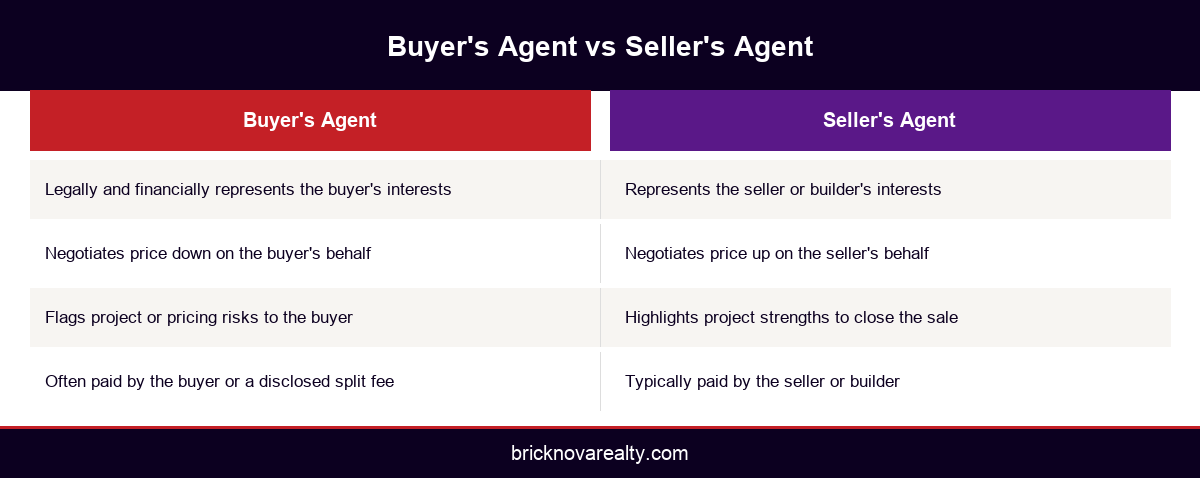
A seller’s agent, sometimes simply called the listing agent, is engaged by the property owner or the builder to market the property and secure the best possible price and terms for the seller. Their fiduciary duty runs to the seller. This means any information you share during a viewing, including your budget ceiling or urgency, can legally and ethically be used by that agent to strengthen the seller’s negotiating position against you.
This is not a flaw in the system, it is how the role is structured. The problem arises when buyers mistake a seller’s agent for a neutral party simply because the agent is friendly, responsive, and appears to be helping. Politeness and professionalism do not change who the agent is contractually obligated to serve.
This holds true even before a specific price negotiation begins. A seller’s agent is trained to highlight a project’s strengths and manage attention away from its weaknesses, since that is precisely what the role is designed to do. None of this is dishonest by definition. It simply means the enthusiasm you hear during a viewing should not be mistaken for independent, neutral guidance.
What a Buyer’s Agent Actually Does
A buyer’s agent works specifically on your behalf, with a duty to negotiate price down rather than up, and to flag risks in a project, a builder’s track record, or a specific unit that a seller’s agent would have no obligation to mention. This includes pointing out overpricing relative to comparable units, construction quality concerns, or unfavourable clauses buried in a sale agreement.
Compensation for a buyer’s agent varies. Some charge the buyer directly, some split a commission with the seller’s side in a way that is disclosed upfront, and some operate on a broader advisory fee model. What matters is that the arrangement is disclosed clearly, so you know exactly whose interests are actually being served throughout the transaction.
A genuine buyer’s agent also brings something a seller’s agent structurally cannot: honest, unfavourable feedback. If a project is overpriced relative to comparable units nearby, or if a builder has a history of construction delays, a buyer’s agent has every incentive to tell you. A seller’s agent representing that exact builder has the opposite incentive, regardless of how forthcoming they may otherwise seem.
Why Realtors Near You Are Usually Working for the Seller by Default
When you search realtors near me or local real estate agents and contact whoever is listed on a specific property, you are almost always reaching the seller’s or builder’s agent, not a neutral party. This is simply how listings work. The agent whose name and number appear on a “for sale” sign is being paid to sell that specific property, not to represent whoever calls the number.
If you want genuine representation, you need to actively seek out a buyer side agent or advisor rather than assuming the person answering a listing inquiry is working for you. Our guide on finding the right real estate agent near you covers how to vet local estate agents specifically for buyer side representation, including the direct questions to ask before assuming anyone is on your side.
A simple test cuts through most of the confusion quickly. Ask the agent directly, in plain terms, who they are contractually obligated to represent in this specific transaction. A genuine buyer side advisor answers immediately and clearly. An agent working for the seller will often pivot to describing themselves as helpful or neutral rather than answering the question directly, which is itself a useful signal.
Why This Distinction Matters More Than the Broker vs Agent Question
Buyers often spend more energy worrying about whether someone is technically a broker or an agent than about who that person actually represents. Our comparison of real estate broker versus agent covers that terminology question in detail, but representation matters more in practice. A seller’s broker is still working against your interests during negotiation, regardless of whether their title says broker or agent.
This is exactly the gap BrickNova’s independent advisory model is built to close. Rather than representing a single seller or builder, BrickNova works from the buyer’s side across multiple projects, comparing options and flagging risks the way a genuine buyer’s agent should. Our step by step guide on how to buy a flat in Kochi walks through what buyer side representation looks like in practice, from initial shortlist to key handover.
For a deeper look at how this advisory model differs structurally from a standard commission based seller’s agent, our explainer on what an unbiased real estate consultant does breaks down the fee transparency principles that make genuine buyer side representation possible in the first place.
Negotiation leverage also shifts once genuine buyer side representation is in place. A seller’s agent negotiating against an unrepresented buyer has little pushback to manage. A seller’s agent negotiating against a buyer with dedicated representation faces a counterpart who understands comparable pricing, project risk factors, and standard contract terms, which tends to produce a materially better outcome for the buyer on both price and terms.
Conclusion
Before your next site visit, ask directly whether the agent in front of you represents the buyer or the seller. If the answer is unclear, evasive, or defaults to the seller by structure, treat everything said during that visit accordingly. Genuine buyer side representation exists in Kerala, it simply requires actively seeking it out rather than assuming the first licensed real estate agent you meet is automatically on your side.
Reach out to BrickNova if you want a shortlist and negotiation approach built specifically around your interests as a buyer, not around closing whichever listing pays the highest commission.
A property purchase is one of the largest financial decisions most buyers make in Kerala’s market. It deserves the same standard of dedicated representation you would expect in any other major transaction, rather than relying on whoever happens to answer the phone when you call a listing.
People Also Ask
Can one agent legally represent both the buyer and the seller in the same deal?
This dual agency arrangement exists in some markets but creates an inherent conflict of interest. Where it occurs, both parties should understand exactly what representation they are actually receiving.
Does hiring a buyer’s agent cost more than using the seller’s agent directly?
Not necessarily. Fee structures vary, and some buyer’s agents operate on a split commission model that does not add extra direct cost to the buyer.
How do I find a genuine buyer’s agent instead of a seller’s agent in Kerala?
Ask directly who the agent is contractually obligated to represent before sharing any details about your budget or urgency. A genuine buyer side advisor will state this clearly upfront.
Is a local real estate agent automatically working for the seller?
Usually yes, if you contacted them through a specific property listing. Independent buyer side advisors exist but need to be sought out separately from listing agents.
What should I avoid telling a seller’s agent during a property viewing?
Avoid disclosing your maximum budget, your timeline urgency, or how much you love a specific unit, since a seller’s agent can use this information to strengthen the seller’s negotiating position.
Do buyer’s agents in Kerala need to be licensed real estate agents specifically?
Licensing requirements vary by transaction type. Confirming K-RERA registration where applicable is a reasonable baseline check regardless of which side an agent represents.
What is the difference between a buyer’s agent and a real estate consultant?
A real estate broker versus agent comparison covers overlapping terminology, though a consultant typically operates on a broader advisory fee model beyond just buyer side representation.
Can a buyer’s agent help negotiate commercial property deals too?
Some can. Our guide on commercial real estate brokerage covers what additional expertise commercial transactions require specifically.
How early in my property search should I engage a buyer’s agent?
As early as possible, ideally before you contact any specific listing agent, so your buyer side representative can guide the search from the very first shortlist.
What happens if I already spoke with a seller’s agent before realizing I needed buyer representation?
You can still engage a buyer’s agent at any point before signing. Be mindful that information already shared with the seller’s agent may have already been used in their negotiating position.