Commercial Real Estate Brokerage: Agents & Brokers for Business Properties


Hiring a commercial real estate agent is a different exercise from finding someone to help you buy a flat. Business properties involve zoning restrictions, lease structures, and due diligence that a residential focused agent may never encounter in years of practice. This guide covers what a commercial real estate broker actually does, how the work differs from residential brokerage, and what to check before hiring a commercial realtor near you.
Whether you are leasing office space, buying a retail unit, or evaluating a warehouse for logistics operations, the wrong advisor can cost you far more than a poorly matched apartment purchase would. The stakes, and the technical requirements, are simply higher.
This is particularly true in a growing market like Kerala, where commercial demand is rising alongside IT corridor expansion, retail growth, and increased business formation across Kochi, Trivandrum, and Calicut. More businesses entering the market means more commercial brokers entering it too, and not all of them bring genuine specialist experience to the table.
This guide is written for business owners, investors, and operators evaluating commercial space, not for individual homebuyers, though many of the vetting principles below apply equally to both situations. If you are specifically looking for residential guidance instead, our broader pillar on real estate agent and broker services in Kerala is the better starting point.
Key Takeaways
- Commercial brokerage requires different expertise than residential, including zoning and lease structuring.
- Pricing in commercial deals is driven by yield and lease terms, not comparable unit sales.
- Verify a commercial agent’s track record with business clients specifically, not just residential deals.
How Commercial Brokerage Differs From Residential
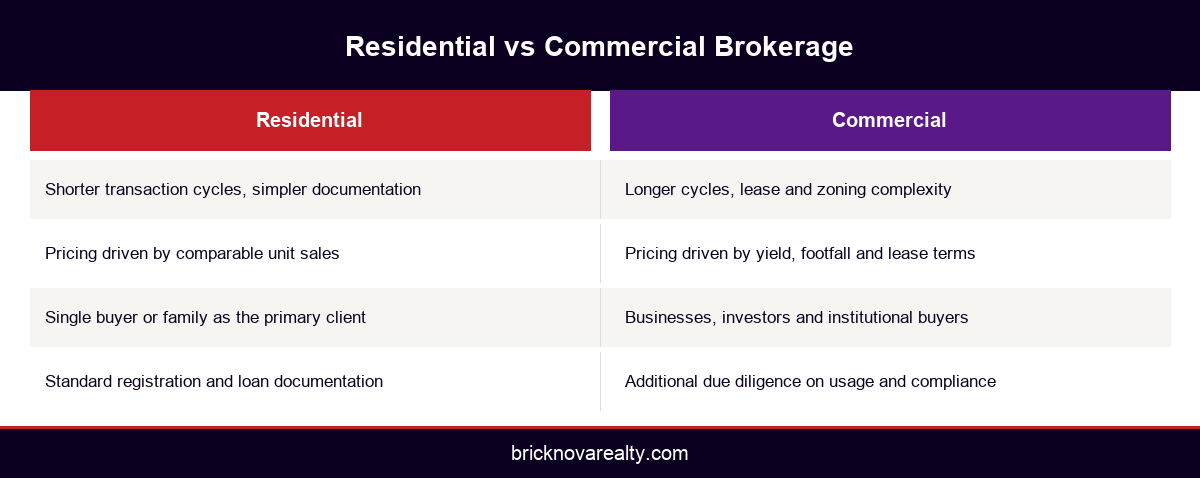
A commercial real estate broker deals with an entirely different set of variables than a residential agent. Zoning classification determines what a property can legally be used for, lease structures vary widely between triple net, gross, and percentage lease arrangements, and due diligence often extends to environmental compliance, parking ratios, and business licensing requirements that simply do not apply to a residential flat purchase.
Transaction timelines also stretch longer. A residential purchase can close in weeks once financing is arranged, while a commercial lease or purchase often involves multiple rounds of negotiation over terms, tenant improvement allowances, and usage restrictions that can take months to finalise. An agent used to fast residential turnarounds may not have the patience or expertise this process requires.
The negotiation itself carries different dynamics too. Commercial deals frequently involve multiple stakeholders on each side, including business partners, investors, and sometimes legal counsel reviewing lease terms before signature. A residential agent used to negotiating primarily with a single family unit may find the layered decision making process unfamiliar, and unfamiliarity here can translate directly into a weaker outcome for you.
What a Commercial Real Estate Agent Should Actually Know
A competent commercial real estate agent should be able to walk you through how a property is valued, since commercial pricing is driven by rental yield, footfall data, and comparable lease rates rather than simple per square foot comparisons used in residential sales. If an agent cannot explain how they arrived at a valuation beyond “this is what similar flats sell for,” that is a sign they are applying residential logic to a commercial deal.
They should also be conversant in the specific compliance requirements for your intended use, whether that is a retail storefront, a restaurant requiring food safety licensing, or an office space with occupancy limits tied to fire safety codes. National policy context from the Ministry of Housing and Urban Affairs filters down into local zoning enforcement, and an agent unfamiliar with this layered regulatory structure can steer you into costly compliance problems after the deal closes.
A strong commercial agent should also be able to model realistic returns for you, including expected occupancy rates, typical lease escalation clauses in the local market, and how a specific property’s location affects long term tenant demand. Generic reassurance about “great footfall” without underlying numbers is a sign the agent is speaking in marketing language rather than actual commercial analysis.
Vetting a Commercial Realtor Near You
Ask for specific commercial transaction references, not residential ones. An agent who closed a dozen flat sales last year but only one commercial lease is not necessarily unqualified, but they are early in building commercial specific expertise, and you should weigh that against the complexity of your specific deal. Confirm registration status through K-RERA where the transaction involves a registered project, since commercial developments fall under the same broad regulatory umbrella as residential ones in many cases.
The same fee transparency principles that apply to residential advisory apply here as well, arguably with higher stakes given the transaction values involved. Our explainer on what an unbiased real estate consultant does covers how to evaluate whether an advisor’s compensation structure genuinely aligns with your interests, a question that matters just as much in a commercial lease negotiation as it does in a residential purchase.
Request a written summary of comparable commercial transactions the agent has closed, including property type, approximate lease value or sale price, and how long the deal took from first engagement to signature. An agent confident in their commercial track record will provide this without treating the request as unusual, while an agent primarily built around residential work may struggle to produce equivalent commercial examples.
Do not overlook the importance of local market knowledge specific to commercial corridors. An agent who understands foot traffic patterns on a particular retail stretch, or vacancy trends in a specific office district, brings insight that generic city wide market data cannot replace. This kind of hyper local expertise typically only comes from someone who has actively worked commercial deals in that exact corridor recently.
Commercial Real Estate Opportunity Alongside Kerala’s Residential Growth
Commercial demand in Kerala often tracks closely behind residential growth corridors. As IT and business districts expand, retail and office demand tends to follow the same population and infrastructure trends driving residential interest in areas covered in our guide to flats and apartments across Kochi. Understanding where residential demand is heading can be a useful leading indicator for commercial opportunity in the same corridor.
BrickNova’s cross builder, independent advisory model extends to commercial brokerage as well, comparing available commercial inventory across developers rather than representing a single project’s sales desk. If you are evaluating office, retail, or mixed use commercial space in Kerala, the same fee-transparent principles that guide our residential advisory apply.
Mixed use developments in particular are becoming more common across Kerala’s growing urban corridors, combining retail, office, and sometimes residential components within a single project. Evaluating these requires understanding both the residential and commercial sides of the market simultaneously, which is exactly where a cross builder, cross segment advisory model has a clear advantage over an agent specialising in only one property type.
Ultimately, the cost of hiring the wrong commercial advisor compounds over a lease term or holding period in a way residential mistakes rarely do. A poorly negotiated lease clause or an overlooked zoning restriction can affect years of operating costs, which is exactly why the extra diligence covered in this guide is worth the additional time upfront.
Conclusion
Commercial real estate brokerage demands a different skill set than residential brokerage, from valuation methodology to compliance knowledge to negotiation timelines. Before hiring a commercial real estate agent or broker, confirm their specific commercial track record, ask how they value properties, and apply the same fee transparency standard you would for any major advisory relationship. Reach out to BrickNova if you want an independent, cross builder view of Kerala’s commercial market.
People Also Ask
What does a commercial real estate broker actually do differently from a residential agent?
A commercial broker handles zoning, lease structuring, and compliance requirements specific to business use, alongside valuation methods based on yield rather than comparable sales.
How is commercial property valued differently from residential property?
Commercial valuation relies on rental yield, footfall, and lease terms, while residential valuation typically relies on comparable unit sales in the same locality.
Do commercial real estate deals in Kerala take longer to close than residential ones?
Generally yes, since lease negotiations, tenant improvement terms, and compliance checks add stages that a straightforward residential purchase does not require.
Is a commercial realtor near me required to have special licensing?
Requirements vary by transaction type. Registered commercial developments fall under the same K-RERA framework as residential projects in many cases, so registration status is worth checking.
Can the same company handle both residential and commercial real estate needs?
Some can, though genuine expertise in both areas is less common than marketing suggests. Our guide on choosing a real estate company in Kerala covers how to evaluate a company’s actual track record.
What compliance issues should I check before leasing commercial space?
Confirm zoning classification, occupancy limits, fire safety compliance, and any usage restrictions tied to the specific business activity you plan to operate.
How does BrickNova approach commercial real estate brokerage?
BrickNova applies the same independent, cross builder comparison model to commercial inventory as it does to residential, rather than representing a single project’s sales interests.
Is commercial real estate a good investment option in Kerala right now?
Opportunity varies significantly by locality and sector. A qualified commercial advisor can walk you through yield expectations for your specific target area and property type.
Do I need a separate broker for a commercial lease versus a commercial purchase?
Not necessarily, though confirm the broker has specific experience with whichever transaction type, lease or outright purchase, applies to your situation.
What should I look for in luxury or premium commercial property brokerage specifically?
Similar principles apply to those covered in our guide on luxury real estate agents, particularly around discretion, verified inventory access, and fee transparency.